Acs Peptide Screening Laboratories Third-party Peptide Analysis
These modifications alter the peptide's organic task and chromatographic account. Peptides are sensitive to temperature level, light, and chemical atmospheres, making them vulnerable to degradation, which influences effectiveness. BOC Sciences offers accelerated security, light stability, and chemical degradation experiments to systematically assess formula security risks.- Documentation testimonial asks whether the record is batch-specific, deducible, and detailed sufficient to be audited.In the common peptide COA context, optimal purity usually refers to the percentage of total chromatogram area represented by the main peptide top.Residual-solvent or water-content examinations can matter in manufacturing or security contexts.
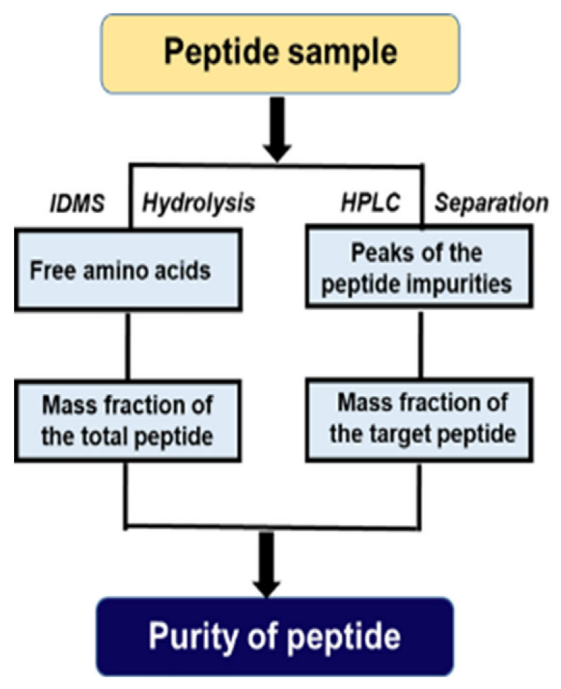
High-performance Liquid Chromatography (hplc): The Pureness Criterion
For researchers, obtaining verified peptides isn't just a rule-- it's the foundation of trusted experiments and study reproducibility. Poor-quality peptides (those with unseen pollutants, incorrect sequences, or deteriorated elements) can bring about deceptive data and irreproducible outcomes. In fact, proteins and peptides are amongst the most commonly utilized laboratory reagents, yet research studies have shown that their high quality is usually inadequate, leading to poor data reproducibility. Starting with proper research laboratory recognition is therefore a vital part of a scientist's quality control operations.

Standard Pureness (≥ 95%)
Unlike a maker's in-house screening, independent third-party laboratory validation is objective and provides impartial results, adding reliability with unbiased logical data. This procedure is crucial for maintaining high peptide top quality because the peptide market is greatly unregulated in lots of places, and without recognition some providers might offer impure, mislabeled, or even phony peptides [3] Visit this link Making certain that each set undertakes correct laboratory testing helps validate the peptide's authenticity and purity, which is vital for both research validity and safety. Peptide pureness describes the percent of your sample that is the right, full-length peptide sequence, free from other peptide-related pollutants. For example, a pureness of 98% suggests that 98% of the peptide material is the designated item, while the various other 2% may be unwanted remnants of synthesis (such as incomplete series or amino acid removal variants).For teams that need much deeper architectural evaluation, the work can likewise be straightened with peptide sequence evaluation and broader characterization support. Amino acid analysis or various other measurable techniques can sustain outright web content. Chiral approaches can resolve enantiomeric purity where stereochemistry is a worry. Residual-solvent or water-content examinations can matter in production or security contexts.As the percent of natural solvent gradually raises during the run, molecules are launched from the column in order of their hydrophobicity-- the more hydrophobic a peptide, the longer it requires to elute (clean off). Considering that impurities generally vary from the target peptide by at least one amino acid, they have slightly various hydrophobicities and show up as separate peaks on the chromatogram. The key point is not to perplex purity (HPLC percentage of the major peptide vs pollutants) with total web content. For experimental preparation (like determining molar concentrations), both pureness and internet material serve numbers, yet purity is what reflects the chemical homogeneity of the peptide example.
A functional assay gauging downstream signaling-- or a structural research utilizing NMR or X-ray crystallography-- requires the highest possible pureness readily available. Crystallographers in particular usually call for ≥ 98% pureness because even minor impurities can stop crystal formation or introduce disorder right into the crystal lattice. As particles exit the column, they go through a detector-- commonly a UV detector set to 214 or 220 nm, wavelengths where the peptide bond absorbs light highly. The detector records just how much UV light is taken in over time, generating a chart called a chromatogram. This guide breaks down what purity in fact implies in peptide chemistry, just how it's measured, what the pollutants are, and just how to check out the documents that verifies a peptide is what it declares to be. This front-end evaluation minimizes rework and improves the possibility that the initial analytical pass will certainly already be decision-useful. A modern-day HPLC system contains Protein Science a number of integrated parts, each serving a details function in the splitting up and discovery procedure. Sign up with over 5,000 active participants and obtain updates on new kid on the blocks and most current lab records. In The KnowGet accessibility to our magazine, new arrivals, and newest laboratory records.